Statement of the Central Committee of RKSM(b) on the upcoming elections to the Russian State Duma in 2026
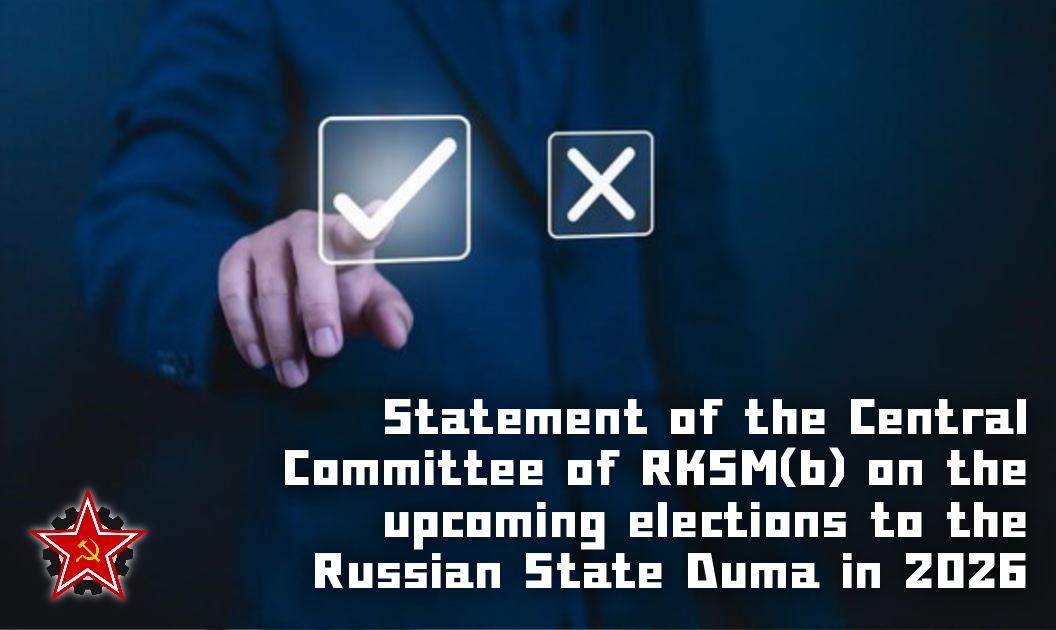
On September 18–20, 2026, Russia will hold elections to the 9th State Duma. Russian communists and the “Left” had already discussed their attitude towards the elections, about which RKSM(b) wrote before. The Komsomol believes it is necessary to state its position towards the next upcoming elections and the illusions held by some organizations regarding them.
The context of the elections
The war launched by the capitalists has been ongoing for more than four years. Russian border and internal regions suffer from Ukrainian drone and missile attacks. Military operations have become mundane facts of life, and destruction and human casualties have become commonplace.
The direct threat to the workers’ lives is accompanied by deterioration of living conditions caused by economic problems. The sanctions imposed on Russia in the very beginning of the war have now been supplemented by direct war damage. Drone attacks against oil refineries, depots and logistics centers disrupt production chains. The lack of gasoline hinders the road traffic, which leads to an increase in the prices of essential goods.
At the same time, the military operations themselves have reached a dead end. Soldiers have been on the front line for years without rotation but there is still a shortage of personnel. Recruiters search new contract soldiers across the state. They actively try to recruit students, which RKSM(b) has written about many times.
Both on the front line and in the rear, people are tired of the war but there is no prospect of its ending. As RKSM(b) warned at the very beginning of the “special military operation”, the war leads to a deepening economic crisis, a further worsening of the situation of the working people and escalating insoluble contradictions.
Balance of class forces
Despite the smouldering discontent with military and economic hardships among the population, balance of class forces has remained unfavorable in recent years. The workers’ movement is weak. The class struggle still takes the form of isolated and local episodes:
- July 2024 – a strike of crane operators in Kazan in response to the beating of a worker by a businessman.
- March 2025 – a strike of bus drivers in Novosibirsk.
- December 2025 – a strike of Yandex taxi drivers in many Russian regions and CIS states.
- July 2026 – a struggle of workers at the Kolomensky bakery plant in Moscow region against unbearable working conditions.
The most conscious, active proletarians, as a result of their struggle, create or join trade union, workers’, and student organizations. The participation of the working class in these organizations is growing gradually.
Nevertheless, the broad working masses still submissively endure humiliation from employers and the state and bear all hardships and deprivations silently.
The passivity of the working people is intensified by the numbness produced by the encounter with the new military reality. The ruling class is whipping up an atmosphere of fear, creating the image of an external enemy and of a struggle against it. The war is being used politically by the bourgeoisie for the further fascization of the ruling regime. The last remnants of bourgeois democracy are receding into the past. Given the weakness of the workers’ movement, there is nothing to set against this tendency: the only real force capable of influencing the political process in the interests of the working people and of restraining the aspirations of the bourgeoisie is absent.
RKSM(b) has already assessed the situation:
“The situation in our country is more and more similar to a mixture of Tsarism and the Pinochet regime in Chili. The prospect of underground work is becoming inevitable for Russian communists.”
Public attitude towards the elections
Aware of its impunity, the bourgeoisie has turned elections into a farce. A mixed proportional-majoritarian electoral system, which allows single-member districts to be arbitrarily carved up, remote electronic voting, and a three-day voting period all make it easier to manipulate election results. The once vigorous struggle at polling stations, where opposition observers caught members of election commissions red-handed, is gone. This fuss, which used to trouble the ruling class, is no longer needed. Now the authorities effortlessly shape the desired outcomes of the “elections” with a simple push of a button.
The public reaction is natural. The voter turnout has been declining since 2011: less than half of voters participated in the State Duma elections in 2016, and in 2021, the authorities managed to gather slightly more than half of all votes only due to unprecedented spending of the election campaign (21.4 billion rubles) and the use of e-voting in some regions. Meanwhile, the authenticity of these votes is questionable.
Severe socio-economic conditions, unfavorable balance of class forces and tyranny of the ruling class hinder the growth of the political activism and consciousness of working people. On the one hand, apathy and disappointment with the current political system increase steadily; on the other hand, millions of working people still have illusions about the fake “elections”. However, even those who recognize the puppet nature of the election process limit themselves various forms of participation in it – from voting for the Communist Party of the Russian Federation (CPRF) “out of spite” to “protest voting”.
Communists’ tactics
Therefore, the current socio-political situation in Russia allows us to draw the following conclusions:
- The political regime is becoming increasingly harsh; the repressions against working people and activists are intensifying.
- Elections are not part of a true political process. The real political trajectory is determined by the balance of class forces outside polling stations.
- Popular masses are alienated from politics and they are just beginning to rise up for the economic struggle, though so far rarely and only at individual enterprises.
- The consciousness of the working people is gradually growing. The unstable socio-economic and military situation can cause a sharp increase in politicization of the masses in the future, but there is no sign of this yet. The example of Ukraine shows that people are often ready to endure much worse conditions.
Under these circumstances, elections are not an arena for the struggle of the working class and communists. The participation in the elections is advisable when the electoral process and the parliament provide a platform to communist from which they can convey their views to masses of working people. However, electing campaigns are barely covered by the mass media today and any reasonably active and prominent candidates are just removed from the elections, also with use of false accusations (the Yabloko party, blogger and CPRF member Nikolai Bondarenko and others).
In turn, an active boycott of elections, a call for the disruption of the electoral process is justified only when consciousness of the working people is high and the contradictions are extremely acute, that is, when a pre-revolutionary situation exists. Thus, the Bolsheviks boycotted the elections to the “Bulygin” Duma during the revolutionary upsurge in 1905 which led to the disruption of the elections and contributed to the rise of the revolution.
Today, all of these conditions do not exist.
RKSM(b) states:
- Bourgeois elections are a tool for deceiving the working people and establishing a bourgeois rule.
- The aspiration to influence political processes today in Russia through participation in bourgeois elections is either a groundless illusion or deliberate deception and betrayal of the working class.
- All hopes that the electoral process can be used as a tribune for agitation and a platform for uniting of the dissatisfied are groundless.
- The tactic of “protest voting” doesn’t influence the election results. It is equally impossible to identify and unite advanced working people through such symbolic actions.
- The class struggle must be waged every day at places of work and study rather than once every few years at polling stations.
RKSM(b) calls on students and working youth to unite at their places of work and study, to boldly struggle for their labour and social rights, their class interests, and to spread worker’s self-consciousness.
Ahead of the upcoming elections, RKSM(b) calls on everyone who considers themselves communists:
- to intensify daily agitation, propaganda and organizational work among the masses;
- to explain the illusory nature of the hopes for changing the situation by electoral means, to reveal a puppet, fake nature of the elections;
- to use a growing interest in politics among individual politically conscious working people to involve them into real struggle;
- to explain to working people their fundamental class interests;
- to promote the growth of a real people’s movement in the form of workers’, trade union, student, women’s and other organizations and associations.
No to bourgeois deception and trappings of parliamentarism!
Yes to the development of the workers’ and students’ movement!